You have been handed an urn holding the ashes of someone close, and you have heard that scattering them at sea is not allowed. A quick search returns contradictory answers: some sources speak of complete freedom, others of fines running into thousands of euros. The doubt tends to arrive at the worst possible moment, when nobody has the patience for red tape.
This article sets out what Portuguese law establishes about the final destination of ashes, explains where the idea of illegality comes from, and covers the practical points worth getting right so that a last wish can be honoured calmly.
In this article you will find:
- What Portuguese law states about the destination of ashes after cremation
- Whether authorisation is needed for a ceremony at sea
- Why the claim about fines circulates so widely
- How a ceremony on board actually unfolds
- What alternatives exist when the sea is not the right choice
Is it legal to scatter ashes at sea in Portugal?
Yes. Portuguese law establishes that ashes handed over to the person who requested the cremation have a free final destination. There is no national rule prohibiting scattering at sea, nor any requirement to obtain prior authorisation to do so. The only formal requirement is that the ashes be transported in a suitable container, and that the act be carried out respectfully.
That is the short answer. It is worth understanding where it is written, because it is precisely the unfamiliarity with the rule that fuels the confusion found online.
What Decree-Law 411/98 says
The instrument governing this matter in Portugal is Decreto-Lei n.º 411/98, of 30 December, amended several times since. It sets out the legal regime for the removal, transport, burial, exhumation, transfer and cremation of human remains, as well as certain of those acts in relation to bone remains and ashes.
The destination of ashes after cremation
Article 24, headed «Destination of ashes», distinguishes two situations. Where the cremation is ordered by the body administering the cemetery, the ashes are placed in a communal ash repository. In all other cremations — that is, the overwhelming majority, those requested by the family — the ashes may be placed in an ash repository, placed in a grave, vault, ossuary or columbarium inside a suitable container, or handed over, also in a suitable container, to whoever requested the cremation, their final destination being free.
That final phrase settles the question. The law does not list permitted or prohibited destinations: it returns the decision to the person who requested the cremation.
Transporting the urn to the location
Article 6 adds that the transport of ashes resulting from cremation, outside the cemetery, is free provided it is carried out in a suitable container. No funeral vehicle is required, no authorisation, no escort. The urn simply needs to be appropriate and properly closed.
This is the only legal requirement with practical relevance across the whole process — and, as we will see, it is also the only point where a penalty genuinely applies.
Is authorisation required? The role of the Maritime Authority
Portuguese law contains no requirement for prior authorisation to scatter ashes at sea from a recreational vessel. The confusion stems from an older practice: for years it was understood that the ceremony had to take place aboard State vessels, and the Navy established internal guidance in the late 1990s so that harbour masters could support requests of this kind, ensuring the dignity of the act and the safety of those taking part.
That support still exists and can be requested, being assessed case by case. But it is available assistance, not a mandatory licence. A family chartering a private vessel does not need the Navy's permission to hold the ceremony.
If the ceremony involves several vessels, an unusually large number of participants, or any circumstance outside the ordinary, contact the harbour master's office for the area beforehand. It is not a legal obligation, but it avoids misunderstandings on a day when nobody wants to deal with surprises.
Why people believe it is prohibited
Posts claiming that scattering ashes at sea is illegal in Portugal, and that the practice can attract fines of around €3,740, circulate regularly. The figure is not invented — but it is being applied to the wrong situation. There are two separate confusions to untangle.
The first is between the sea and public land. Scattering ashes in a municipal garden, a park or another public space on land may conflict with municipal regulations and with environmental or public health rules, and may require prior contact with the council or parish authority. Scattering at sea, carried out from a vessel offshore, is not in that position.
The second concerns where the figure comes from. The fine of roughly €3,740 corresponds to the maximum ceiling set out in article 25 of the same decree-law. That article, however, applies to a closed list of specific infringements — such as the removal of a body by an unauthorised entity, the irregular transport of a body outside the cemetery, or burial outside a public cemetery. Scattering ashes at sea does not appear on that list.
There is, on the other hand, a considerably lower penalty attached to transporting ashes in a container that is not suitable. In other words: the only real and verifiable risk in this whole process is not scattering the ashes — it is transporting them badly.
How a ceremony at sea unfolds, step by step
In practice, a private ceremony at sea comes together in a few steps:
- Choosing the date and time. The family proposes the date. Early morning or late afternoon are usually preferred, as the sea tends to be calmer and the light softer.
- Reserving the boat exclusively. The vessel is booked for the family or close group alone. There are no other passengers on board.
- Defining the ritual. The family decides everything: whether there will be words, music, flowers, a reading, or simply silence. No format is imposed.
- Departure and choice of point. The boat proceeds to a point offshore, away from swimming areas and other vessel traffic, and slows.
- The moment of scattering. The ashes are placed in the water with the vessel positioned so that the wind is favourable. Flowers, where used, follow.
- The return. A period of silence and an unhurried return are customary. The coordinates of the location can be recorded and given to the family.
Practical and environmental considerations
A few details make a real difference on the day and are easy to get right:
- A biodegradable urn. Not required by law, but the recommended choice when the intention is to place the whole urn in the water: it dissolves and leaves no materials behind.
- Loose flowers, no plastic. Avoid cellophane, ribbons, floral foam and wire. Loose petals and stems carry the same symbolism without leaving waste.
- Wind direction. The most underestimated detail. The crew positions the vessel so that scattering happens from the sheltered side, avoiding awkward moments at a sensitive time.
- Sea conditions. Heavy swell or strong wind take the calm out of the occasion. Rescheduling is always better than pressing ahead.
- Personal items. Letters, photographs and small keepsakes are common. If they are not biodegradable, the most respectful choice is to bring them back.
Alternatives to the sea
The sea is not the right choice for every family. The other options set out in law are worth knowing:
| Option | Where it is | Suited to |
|---|---|---|
| Ash repository | A dedicated space in a cemetery for the communal deposit of ashes | Those seeking the simplest option, with no upkeep |
| Columbarium | A structure with individual niches, in a cemetery or crematorium | Families who want a fixed place to visit |
| Family vault | A plot already held by the family | Those wishing to maintain an existing family tradition |
| Memorial garden | A green space created by some crematoria | Those who want a natural setting, but on land |
| Scattering at sea | Offshore, from a vessel | Those with a connection to the sea, or who expressed that wish |
Holding the ceremony in Cascais and the Lisbon area
In the Cascais area, ceremonies usually depart from Cascais Marina. Cascais Bay has the advantage of being relatively sheltered, which helps on windy days, and allows offshore waters to be reached quickly without a long passage — something that matters when older relatives are on board.
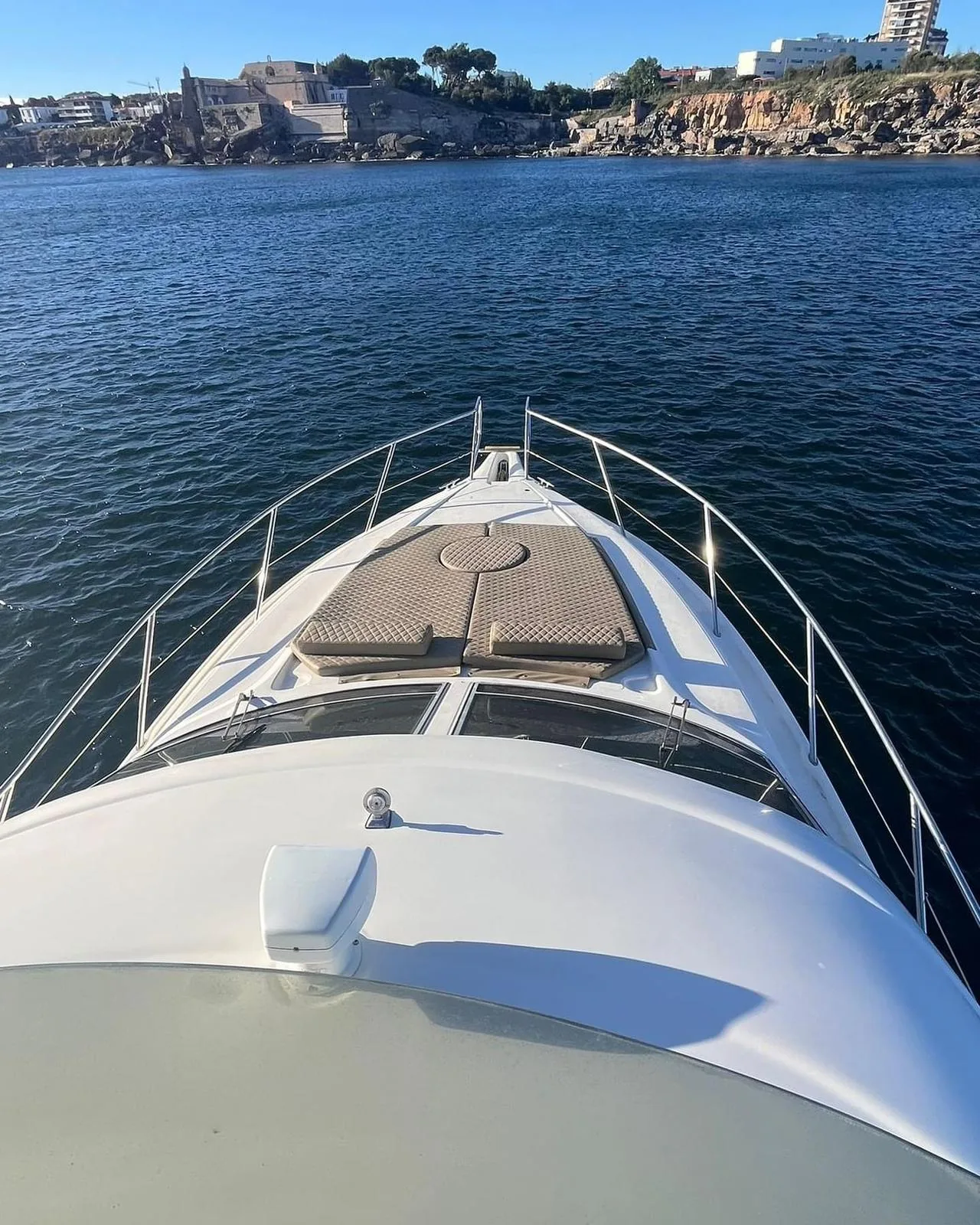
From here the ceremony can take place off Cascais, off Estoril, or towards the mouth of the Tagus, depending on the family's attachment to a particular place. Further detail is available on the page for ashes at sea ceremonies in Cascais, and you can see the boat before deciding.
Conclusion
Scattering ashes at sea in Portugal is lawful. The law places the decision on the final destination with the person who requested the cremation, and requires no prior authorisation for a ceremony held from a private vessel. The one requirement carrying legal weight is transport in a suitable container — everything else is common sense, environmental care and choosing the right day.
If you are arranging a ceremony of this kind, the hardest part is rarely the paperwork. It is deciding how to say goodbye. The practical side can sit with people who do this regularly.
Frequently Asked Questions
Ceremonies at sea with Paiva & Branco
Paiva & Branco Rental Boats arranges private ashes at sea ceremonies departing from Cascais Marina, Pontoon M. The vessel is reserved exclusively for the family or close group, with no other passengers on board, and the ritual is defined entirely by those living it — words, music, flowers or silence.
The crew accompanies the occasion discreetly, handles the choice of location and the positioning of the vessel, and keeps the right distance. The practical side stays with us, so the family can focus solely on the farewell.
Talk to us about a ceremonyRelated articles
When Is the Best Time for a Boat Trip in Cascais?
Sea conditions vary considerably through the year and through the day. Useful for choosing a ceremony date with the best chance of calm water.
Read articleSources consulted
- Decreto-Lei n.º 411/98, of 30 December (articles 6, 24 and 25), as amended — Diário da República
- Portuguese National Maritime Authority and Portuguese Navy — powers of harbour masters
- Municipal cemetery regulations published in Diário da República — penalty amounts for infringements
This article is for information only and is not a substitute for legal advice. In particular circumstances, please confirm with the municipal council, the parish authority or the local harbour master.